The snake is a widely used motif across various cultures, employed to represent a range of energies, from creation and healing to danger and deception. Here, as usual, I aim to consider and explore its non-dualistic and evolution based significance in relation to programs.
One of the most commonly used snake-related symbols is the “ouroboros,” the snake or dragon biting its own tail, which more or less symbolizes the eternal cycle of nature, its cyclical nature, and continuous renewal. In many depictions, the symbol is still portrayed as a dragon with legs, which is interesting because the dragon dominated the previous year, revealing a kind of transformation as the dragon becomes a snake. This is also noteworthy because millions of years ago, snakes had legs, and in some species the vestigial remnants of their evolutionary past can still be observed.
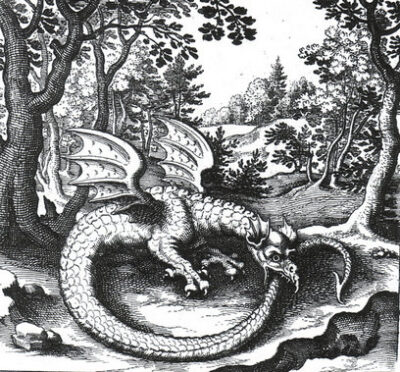
The concept of “progress without legs” or “progress without movement (legs, limbs = motion)” can be interpreted as a form of “spiritual or inner progress.” From the perspective of program theory, the ideal goal of this is a state where “we no longer react,” meaning we have let go of the program that limited or hindered us, or in other words, “we have shed our old skin.” This beautifully aligns with the processes occurring within us during the Year of the Dragon. Its theme was that, due to various environmental influences, we moved from a subordinate position to one of dominance, establishing our boundaries. Only after this, when our self-esteem stabilizes through growth, can we finally and fully release the defense or escape-related programs and response reactions we no longer need. (By biting its own tail, the dragon deactivates the programs/reactions related to escape [tail] and attack [head]. As the snake grows, it sheds its skin, leaving behind the limiting programs.)
The “I don’t react” state, free from conditions and programs, essentially corresponds to the biblical paradisiacal state, where we feel no lack, nothing is missing, and everything is perfect as it is. Interestingly, in the Garden of Eden, it is the snake that introduces the sense of lack, the desire for knowledge and abilities. However, the expulsion and loss of Eden don’t involve a change of location but rather a shift in our mindset and perception, driven by changing needs. In our cognitive evolution, we first create programs, and when they become overly restrictive, we reduce them, returning to a state of unconditionality.
Thus, the snake in the creation story is not an “external corrupter” but a visual representation of the desires and needs arising from the lack within us, both in physical and non-physical forms. These energies create the cyclical nature, evolution, and continuous renewal of the natural world.
In general, snakes have an extremely efficient digestive system, and their entire organism’s superpowers are focused on “engulfing the morsel.” Many bones in their skulls are not fused, allowing them, along with their highly expandable esophagus and stomach, to swallow prey much larger than their head.
When engulfing a sizable morsel, they may retreat for weeks or months to digest, during which they can significantly increase the production of stomach acid and digestive enzymes. Some venomous species even have venom that contains enzymes to aid in pre-digesting food.
So, if 2025 is the Year of the Snake, what can we expect?
In 2025, a new cycle begins (already palpable now), bringing significant changes that may initially feel uncomfortable to integrate into our lives but will support our growth in the long term. The emphasis is partly on “engulfing” and partly on renewal.
This means we’ll likely be able to tackle, swallow, and integrate much larger “morsels” into our lives this year. If we face losses, we’ll process them more easily than usual.
As such, it may be a good time to embark on bigger projects, such as major lifestyle changes, starting a new business, switching jobs, forming new partnerships or collaborations, moving or renovating, or beginning new studies and acquiring new knowledge. (Here I warmly recommend exploring the Five Biological Laws - courses!) These time- and energy-intensive processes will be easier to execute and integrate into our daily lives this year.
This text does not aim to be comprehensive; it touches on only a part of the topic and serves to understand the biological processes occurring within us and the nature of conflicts. Every person’s life and life path are unique, so the specific triggers should be examined individually, based on the events experienced. How someone copes with their conflicts varies from person to person, and different areas are handled differently depending on the amount of negative experiences or failures accumulated there. Exploring a conflict does not replace medical care.
Articles, you may interested in: