THE EMOTIONAL BACKGROUND OF MAMMARY GLAND CHANGES
When discussing breast changes, we mostly talk about the involvement of 2 types of tissues: the mammary glands, ancient connective tissues, and the milk ducts, squamous epithelial tissues.
The mammary gland is a modified skin dermis, a membrane tissue, that synthesizes milk from blood.
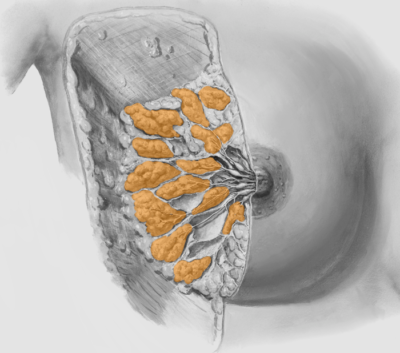
It's a natural process in the female body that, starting from ovulation, with the increase in progesterone levels, the breast's glandular tissue begins to grow, the cells of the gland lobules start to divide so that by the time the baby is born (in case of fertilization), they are prepared to feed the offspring.
Thus, it's a well-known fact that in case of demand (pregnancy), the mammary gland tissues begin to proliferate so that the "milk factory" can meet the expectations by the due date - because the amount of milk produced depends on the number of mammary glands.
From the moment the newborn latches onto the breast, the prolactin hormone activates the function of the mammary glands, initiating milk production to feed the cared-for infant.
When a change, such as a tumor (diagnosis: mammary gland tumor, mammary carcinoma), is found in the breast, the same demands cause this tissue proliferation, but not necessarily due to an impending childbirth.
Therefore, behind breast cancer, according to the function of the mammary gland, there is an emotional conflict where "I want to/should care for someone (any living being), but I can't, I don't have the capacity/time/money/energy."
As a result, in the presence of emotional frustration, mammary gland tissues start to proliferate with the aim of solving the problem, to "have the capacity to care for the person/animal," and this continues until the situation finds some resolution or the emotion is expressed. When this happens, and there's no longer a need for care, the extra tissues are broken down through tuberculous disintegration, accompanied by mild inflammation, edema, and mycobacteria.
Since the mammary gland is a modified skin dermis, it reacts to attack or insult in a special way, particularly in situations where we want to please a loved one but can't, leading to conflict. Just as breastfeeding or offering a pacifier, ("I'll put a pacifier in their mouth so they at least won't scream") is an effective method to calm crying, screaming infants in most cases, "feeding" can also be used to soothe "tantrum-throwing" adults - "I'll feed them so they won't cry."
Therefore, if we can no longer find a solution to disputes, frictions, or discord with our relatives or loved ones, the conflict is often resolved through the mammary glands - in an effort to calm and soothe the person involved as quickly as possible. In this way, relationship/marital discord can also lead to changes in the breast's mammary glands.
THE EMOTIONAL BACKGROUND OF MILK DUCT CHANGES
The milk ducts transport the breast milk—maternal care, nourishment, and love—produced by the mammary glands to the loved one in need of care. The ejection of breast milk—the "movement of the morsel"—is facilitated by smooth muscle in the walls of the milk ducts, triggered by oxytocin production in the pituitary gland when the infant begins to suckle.
The milk ducts are derived from the skin’s epithelium (external skin sensory system), and their function is separation and conduction.
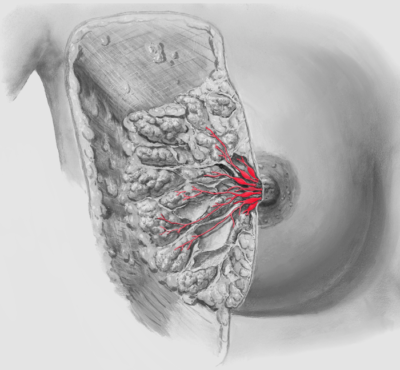
Essentially, the milk ducts represent the channel, the connection, the link between the caregiver and the cared-for, through which the life-giving fluid—nourishment, love—can be transferred, expressed, or shared.
If something hinders this process, if an obstacle blocks the flow in the "channel," or if something prevents us from adequately providing (emotional) nourishment, the squamous epithelium of the ducts begins an unnoticed degeneration, creating an increase in diameter to dislodge the obstructing factors and restore free flow.
This can occur literally in the context of breastfeeding, if we feel that something hinders us from breastfeeding our child properly (in the right way, at the right pace) or according to expectations, "correctly."
Or, figuratively, if we have previously been able to share our love with a loved one (partner, close friend, or anyone we feel close to), but now we cannot due to some obstacle—such as distance—or because the other person "builds walls around themselves." They used to express their love, but suddenly they shut down, become emotionally inaccessible, and the relationship grows cold.
As long as we feel disturbed by this, the squamous epithelium thins. When we manage to resolve the issue or express the related emotions, the epithelium begins to regenerate and replenish, accompanied by hypersensitivity, edema, inflammation, viruses, and tissue proliferation. Depending on the intensity of the conflict, we may experience breast enlargement, inflammation, or even pain. During an epileptoid crisis, the thinned epithelium of the milk ducts may become obstructed due to smooth muscle contractions, leading to fluid accumulation, which resolves after the crisis. (This is often diagnosed as an intraductal "cyst" or ductal carcinoma.)
Breast changes (like others) become particularly severe when secondary conflicts, diagnosis-related conflicts, or fear of illness accompany them. Even changes resulting from long-lasting, intensely experienced conflicts can regenerate (by the end of the post-conflict resolution phase) if the conflict activity is truly resolved and we support our body’s transformation processes patiently, without the "fear of diseases."